

Colombian gold traceability: how to verify origin
Colombia requires mineral transactions to be recorded in the Mineral Traceability Platform (PTM) of its National Mining Agency (ANM). This is how that record works for gold, and what you can ask your Colombian supplier.
Updated on
 MinTrace is an Technology Operator for Mineral Traceability (OTTM) authorized by the ANM

A Technology Operator for Mineral Traceability (OTTM) is a company authorized by Colombia's National Mining Agency (ANM) to record and transmit mineral trading transactions to the Mineral Traceability Platform (PTM), under ANM Resolution 759 of 2024.
Colombia's legal framework
ANM Resolution 759 of October 28, 2024 (opens in a new tab)
Creates the PTM and defines the OTTM. Transactions are recorded in the PTM through an OTTM, either a private authorized operator or the one the ANM makes available.
ANM Resolution 3824 of December 29, 2025 (opens in a new tab)
Sets the voluntary transition and the date from which recording is mandatory for each category, starting November 19, 2026 for large-scale mining.
The certificate of origin and the acceptance code

Certificate of origin
The document that proves the lawful origin of the mineral for mining title holders and other producers. For subsistence miners, the equivalent document is the production declaration.

Acceptance code
The code the PTM returns when a transaction is accepted. MinTrace stores it with the transaction and its supporting documents, so your supplier can show what was reported.
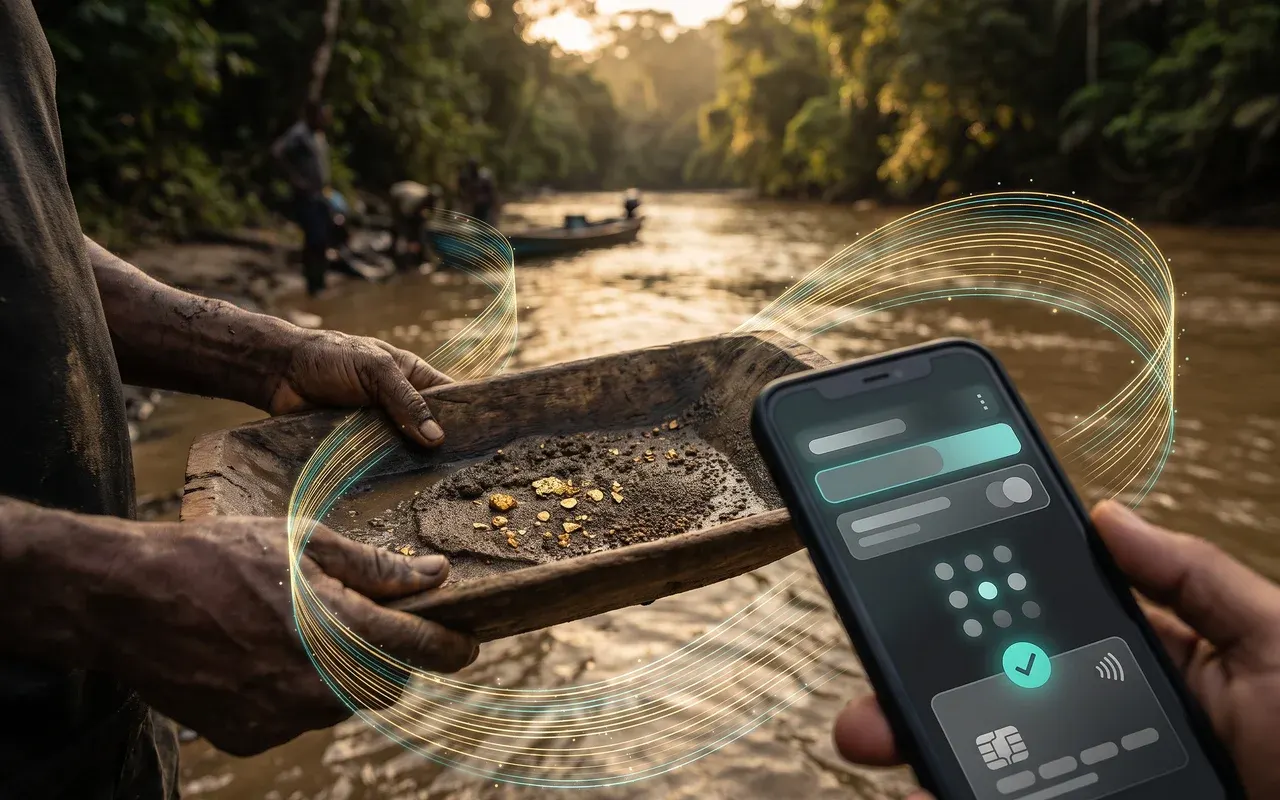
Gold bought from subsistence miners
Is recorded by the buyer registered in the Single Registry of Mineral Traders (RUCOM) (Colombia's registry of mineral traders), and the miner authorizes the purchase with an acceptance code.
Colombian gold exports and their chain
Gold is the largest item in Colombia's mining exports. According to Bulletin 26, "Minería en cifras", of Colombia's Mining and Energy Planning Unit (UPME), February 2026 (opens in a new tab), gold accounted for 40.6 % of the country's 2025 mining exports, about USD 4,616 million FOB (free on board), 12.5 % more than in 2024.
Exports leave almost entirely from one department: the same bulletin reports that 97.8 % of the unwrought gold exported in 2025 recorded Antioquia as its origin, and that its main destinations were the United States (31.3 %), Canada (17.0 %) and the United Arab Emirates (16.5 %).
Upstream, the chain is long. A buyer can purchase from subsistence miners, from mining title holders and from other traders, and smelting gold into doré is recorded as a transformation. For subsistence miners, Ministry of Mines Resolution 40103 of 2017 (opens in a new tab) caps sales of precious metals at 420 grams per year per miner, with a monthly average of 35 grams, and the PTM rejects a purchase that exceeds the yearly quota.
For investors and international buyers
With Mineral Invest, an investment manager can give its investors access to the production process of each lot, from the mine to the export, on a site under its own brand. MinTrace does not make securities offerings or manage third-party funds.
What the OECD due diligence guidance is
The OECD Due Diligence Guidance for Responsible Supply Chains of Minerals from Conflict-Affected and High-Risk Areas is an international framework that describes how companies can identify and manage risks in their mineral supply chains.
MinTrace organizes the origin evidence and the supplier due diligence of Colombian companies: registry checks, restrictive lists and supporting documents. Whether a supply chain meets any standard is assessed by the buyer or its auditor.
Questions to ask your Colombian supplier
Which OTTM do you use to record your transactions in the PTM?
Can you share the acceptance code and the PDF certificate for this sale?
What document proves the origin of the gold: a certificate of origin or a production declaration?
Are you registered in the RUCOM, and do you check your own suppliers against it and against restrictive lists?
From what date is recording in the PTM mandatory for your category?
Authorized by Colombia's National Mining Agency (ANM)
MinTrace is a Technology Operator for Mineral Traceability (OTTM) authorized by Colombia's National Mining Agency (ANM) since December 17, 2025 (filing number 20253210663711).
Questions about a Colombian supplier?
Our team can explain what a MinTrace record contains and how to read it.
Frequently asked questions
Is gold traceability mandatory in Colombia?
Yes, in stages. ANM Resolution 3824 of 2025 makes recording in the PTM mandatory from November 19, 2026 for large-scale mining and Projects of National Interest, and later for subsistence, medium-scale and small-scale mining, through 2028. Until each date, recording is voluntary.
Does MinTrace guarantee compliance with OECD, EU or LBMA requirements?
No. MinTrace organizes the origin evidence and the supplier due diligence of Colombian companies and reports their transactions to the PTM. Whether a supply chain meets any international standard is assessed by the buyer or its auditor, not by MinTrace.
What can my Colombian supplier show me?
For each sale recorded in MinTrace: the sale record, a PDF certificate of the transaction and the acceptance code returned by the PTM, together with the document that proves the origin of the mineral, such as a certificate of origin or a production declaration.